
色妹妹直播


Resources for Clinical Educators
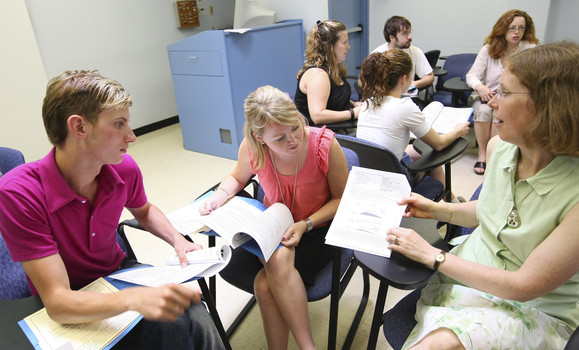
Students enrolled in the speech-language pathology and audiology programs at the School of Communication Sciences and Disorders (SCSD) participate in a number of clinical placements during their three years of study. These clinical placements take place in a variety of settings, such as hospitals, schools, and public or private clinics, with various client populations, including opportunities for placements with culturally and linguistically diverse clients.

We rely on the generosity of speech-language pathologists and audiologists, within Nova Scotia and throughout the country, who serve as clinical educators for our graduate students.听

Become a Clinical Educator

If you are an audiologist or speech-language pathologist with a minimum of one year of work experience and would like to become involved in clinical education, we would like to hear from you! In addition to work experience, clinical educators are required to hold a minimum of a master's degree in speech-language pathology or audiology and be eligible for certification with . 

Clinical educators as well as students benefit from the experience.  Below are 10 good reasons to supervise a student:

  • You will experience personal satisfaction in watching students grow as professionals
  • You will be educating and meeting your future colleagues and will become infused with their enthusiasm
  • You will gain new perspectives on clinical practice and develop skills in adult education
  • You may learn about new technologies and trends in clinical practice
  • You may be able to alter or expand services for clients, families, and caregivers
  • You may find it refreshing to have a new person on-site
  • You may be able to recruit new staff
  • You can access university resources
  • You will earn continuing education credits for SAC or your provincial regulatory body
  • You may feel that it is your responsibility to educate the next generation of professionals

If you would like more information about supervising a speech-language pathology or audiology student, please contact one of the clinical coordinators at the School of Communication Sciences and Disorders. Thank you for your interest in clinical education.

Adjunct Clinical Associate Application


Eligibility criteria

  • License to practice as an audiologist or speech-language pathologist, if applicable in your province.

  • Clinical educator for a minimum of one full-time, 12-week audiology or speech-language pathology practicum placement (or equivalent; approximately 480 hours) from 色妹妹直播鈥檚 School of Communication Sciences and Disorders per year for three consecutive years.

OR

  • A current practicum site clinical education coordinator who has been instrumental in securing audiology or speech-language pathology student placements on a consistent basis.


Submit application form and curriculum vitae by email to the SCSD Administrative
Manager
, fax (902-494-5151) or mail: 

School of Communication Sciences and Disorders
Attention re: Adjunct Clinical Associate
色妹妹直播
PO Box 15000
5850 College Street
2nd Floor, Room 2C01
Halifax, NS B3H 4R2

Forms

 - [PDF - 149 KB] 
 [PDF - 143 KB]

Supervision Guidelines for Student Placements

The amount of supervision a student will need depends upon the type of task assigned, the client population, and the student鈥檚 competence and level of training (fall practicum, winter practicum, internship, or externship placement). Supervision should include direct observation, feedback, and guidance to allow the student to evaluate and improve his/her performance and ultimately develop clinical competence.

As a general rule, the School of Communication Sciences and Disorders recommends the following guidelines for supervision of speech-language pathology and audiology students completing practicum placements:

  • Supervise at least 25% of all treatment sessions
  • Supervise at least 50% of each assessment session
  • Supervise 100% of interventions that carry significant risk of harm, including, but not limited to, taking an initial case history, communicating results and recommendations to clients and/or caregivers following an initial assessment, tracheoesophageal puncture care/voice prosthesis placement, dysphagia assessment, ear mold impressions, participating in hearing aid prescription procedures, and cerumen management

These are minimum requirements and should be adjusted upward if the student's level of knowledge, experience, and/or competence warrants such modifications. For example, 2nd year speech-language pathology students completing fall and winter practicum placements require more supervision than the minimum standards listed above. They will require direct training and active feedback during these initial practicum experiences.

Clinical educators must be available to consult with the student when he/she is providing clinical services to clients. The clinical educator should typically be on-site or delegate to an on-site alternate clinical educator who meets the requirements for student supervision if he/she plans to be away.

References

  • American Speech-Language-Hearing Association. (2008). .
  • Nova Scotia Regulator of Audiology and Speech-Language Pathology (2025). .

Roles and Responsibilities

Faculty

Though faculty in the School of Communication Sciences and Disorders (SCSD) may have few interactions with students in practicum settings, the information they impart in class will have a direct and profound impact upon students鈥 clinical performance. The primary faculty contributions to the clinical education experience are:

  • To provide relevant information regarding speech and language development and normal processes of speech, language, and hearing;

  • To provide relevant and up-to-date information regarding the nature, assessment, and treatment of speech, language and hearing disorders;

  • To provide 鈥渂ridges鈥 for the clinical application of the above information;

  • To participate in collaborative efforts to share current information impacting upon assessment and intervention;

  • To encourage students to become independent and life-long learners and problem-solvers;

  • To teach and model fundamental principles involved in professionalism.

Students

Student participation in the clinical education experience can be thought of as a dual role. First, the student is responsible for completing the appropriate administrative and professional duties that are demanded from the practicum and placement process, including completion of all placement requirements such as immunizations and criminal record checks, obtaining a list of recommended readings and/or materials to review prior to commencement of the placement, and ensuring required forms are signed and returned to the school. Second, the student is also responsible for developing the competencies that will allow for successful completion of the program and the beginning of independent practice.

The student plays an active and changing role in the clinical education process. In order for that role to evolve as the student does, the student needs to recognize both his/her strengths and limitations as each practical experience is approached. In addition, students are expected:

  • To integrate the information presented in class lectures and readings;

  • To seek to extend that knowledge via additional readings, professional dialogue, etc.;

  • To take responsibility for their own clinical education, in conjunction with clinical educators and faculty, to ensure an experience that is adequate and appropriate to their individual needs;

  • To assist other students in developing clinical abilities by actively mentoring those with less experience;

  • To provide evaluative feedback regarding their clinical education experience so as to improve the training of future students, and foster the development of clinical educators;

  • To develop professionalism.

Clinical Educator

Given that a student鈥檚 clinical skills evolve over time, the clinical educator鈥檚 role in the practicum process must also change. Initially, the clinical educator provides direct teaching and instruction, with a gradual shift to a more collaborative relationship. The clinical educator offers support as the student becomes more actively involved in the clinical process, while simultaneously facilitating the student鈥檚 growing independence. Ultimately, there is a transition on the clinical educator鈥檚 part to the role of consultant, at which time the clinical educator participates in information-sharing and joint problem-solving with the student.

It is also the clinical educator鈥檚 role within the practicum process to evaluate the students鈥 development of clinical skills. This allows for the identification of clinical strengths and weaknesses, and assists in planning programs that meet the individual needs of students. In summary, the clinical educator is responsible for:

  • Discussing and/or demonstrating clinical procedures and participating with the student in the clinical process;

  • Following supervision standards, as determined by the school;

  • Assisting the student in observing and analysing assessment and treatment sessions;

  • Assisting the student in developing and refining assessment skills;

  • Assisting the student in developing clinical goals and developing and refining clinical management skills;

  • Facilitating the student鈥檚 self-evaluation of clinical performance while enhancing the student鈥檚 clinical independence;

  • Assessing the student鈥檚 development of clinical skills and providing ongoing feedback to the student (including completing mid-term and final evaluations with the student);

  • Demonstrating and modelling professionalism to students and assisting them in refining their own professional attitudes and behaviours.

Clinical Education Academic Coordinator

The academic coordinators of clinical education at the School of Communication Sciences and Disorders (SCSD) serve as the link between clinical education sites and the school and act as the liaison between the clinical education site coordinator, clinical educator, and student. They organize, coordinate, and evaluate the clinical education component of the SCSD speech-language pathology and audiology programs. In addition, the clinical coordinators are responsible for:

  • Providing an orientation and/or orientation materials to the clinical educator;

  • Providing the student and clinical educator with information about expectations, goals, student competencies, and specific forms;

  • Arranging continuing education certificates for the clinical educator;

  • Offering ongoing support to the clinical educator and student;

  • Assigning a grade of pass/fail to the student at the end of the practicum placement.

Preceptor Education Program

is an online interprofessional program with eight interactive learning modules. Each module takes 30-45 minutes and aims to support health professionals and students preparing them for real-world practice.

These Preceptor Education Program (PEP) Modules are provided by the University of Western Ontario, Fanshawe College and the Middlesex-London Health Unit (PHRED Program)

Preceptor Education Program is licensed under a

Speech-Language Pathology
Emily Balkam
ceslp@dal.ca


Audiology
Sarah Mason
ceaud@dal.ca