

Canada's federal government has committed to cutting agricultural emissions from fertilizer use and methane by 30 per cent below 2020 levels by 2030. It is an ambitious goal that鈥檚 going to take significant commitment and collaboration from farmers and the 2.3 million people employed in Canada鈥檚 agri-food systems that generate seven per cent of the country鈥檚 gross domestic product. 听
It's a diverse group whose livelihood often depends on tight margins and the use of fossil fuels. Introducing policies to pursue a net-zero future is not a straightforward task. This is where 色妹妹直播 sociologist Dr. Karen Foster comes in.
The researcher was selected to lead a $1.9-million initiative supported by Agriculture and Agri-Food Canada and the Social Sciences and Humanities Research Council to develop a new national research network that supports an equitable transition to net-zero in Canadian agriculture and its periphery industries.
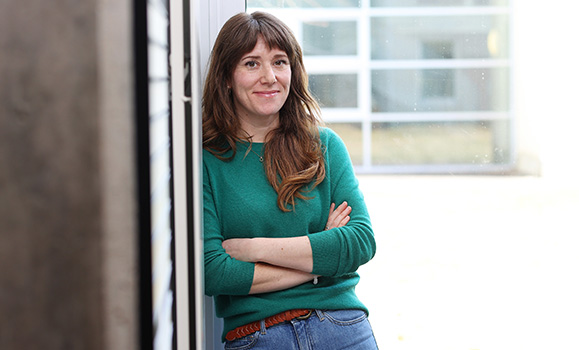
Dr. Foster says the network was created to leverage research in the social sciences and humanities to understand barriers to shifting to less carbon-intensive agricultural systems and how to overcome them. She says great strides have been made in the natural sciences and engineering, but more needs to be done to investigate the social side of the transition, including how advances can be implemented in ways that distribute costs and benefits equitably.
Solving problems early
鈥淭he goal of the network is to land us all on 鈥楥ommon Ground鈥�, which is the name of the network,鈥� she says. 鈥淲e need to look at what the challenges are of moving towards net zero in food systems. What problems arise when you introduce new policies. The idea is to get researchers and people in the sector into conversations early, so that we're identifying gaps and tensions, and working to resolve them through policy with end users in mind.鈥�
She says the researchers linked by Common Ground Canada Network will collaborate to share knowledge and work with people in the industry and community food organizations. The ambition is to assess systemic issues that could ultimately become impediments to Canada鈥檚 net-zero ambitions.
鈥淥ften the social sciences are brought in at the end once the technical solution to a problem is defined but there is hesitancy in the public to adopt it. Then we're called on to try and figure out what's wrong with people rather than the policy,鈥� says Dr. Foster. 鈥淏ut it really needs to start earlier than that. There has to be interdisciplinary research that has social scientists and humanities scholars in there from the get-go to help frame the questions and the approach.鈥�
A different kind of ecosystem
The Common Ground Canada Network will be based at 色妹妹直播 and currently includes 28 partner organizations across the country, with plans to grow that number. Including academic institutions, research teams, centres and institutes, civil society organizations, and other community partners, the network鈥檚 members have deep experience working with people in the agricultural sector. Dr. Foster says their embedded expertise has earned them relationships of mutual trust, reciprocity, and respect.
The agriculture and agri-food sectors comprise a complex ecosystem that employs one in nine Canadians, from farmers and fishers to manufacturers and supply chain actors. Dr. Foster says the parts make up a complicated system of interdependent relationships that require a social-science perspective to fully map and digest them.
She references 色妹妹直播 researcher Dr. Phoebe Stephens who tracked venture capital investment in Canadian agriculture and discovered that more funding went to innovations in food retail than technologies with the potential to lower carbon emissions. Among many other areas, network researchers are studying barriers for people to enter or remain in the agricultural sector and how 鈥榝ake meat鈥� could gain market acceptance to provide a viable alternative to more carbon-intensive products.
A relationship problem
鈥淐limate change is a relationship problem, which is a perspective that you mainly get from the social sciences and humanities,鈥� says Dr. Foster. 鈥淲e need to understand what are the right relationships between urban and rural Canada to facilitate technological change? What are the right relationships between people and food, people and the environment. These relationship issues need to be sorted out in order to advance on net zero.鈥�
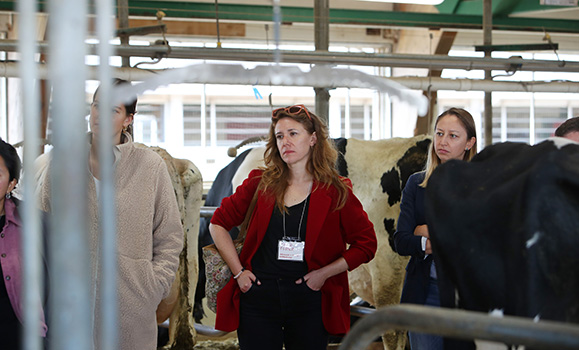 Dr. Foster visits Faculty of Agriculture facilities during the Food Futures program.
Understanding the systems that underpin Canadian agriculture will also help network researchers guide their more STEM-minded peers, says Dr. Foster. Teams developing technological solutions funded by the Natural Sciences and Engineering Research Council of Canada will be key partners. They鈥檒l be invited to consider how to approach farmers who may feel overwhelmed by accelerating changes in their industry and to adapt technologies to make them more acceptable.
鈥淭here are people saying, 鈥楾his is too much, this is not the farming I got into,鈥� and asking questions like, 鈥榃hat are the skills that I need in my workers?鈥�" says Dr. Foster. 鈥淭hat's the kind of thing that a social science-informed case study approach can help think through, from the handy new tool to all of the knock-on effects.鈥�
More than zero
Dr. Foster says culture needs to be a key consideration, highlighting that carbon-reduction policies must reflect the needs and rights of equity deserving groups like African Nova Scotians and Indigenous people residing in Canada.
鈥淚t's clear that African Nova Scotians and Indigenous people are focused on food sovereignty, food security is not enough,鈥� she says. 鈥淚t's not about just making sure people have access to food, it's about the freedom and the power to control every aspect of the way food is produced, distributed, and consumed.鈥�
Dr. Foster says that there may be tensions as Canada pursues net-zero goals and its commitments to Truth and Reconciliation and the righting of historical wrongs. But she says social science and humanities researchers are ideally suited to help reconcile the ambitions.
鈥淲hile shifting Canadian agriculture to net zero is necessary,鈥� says Dr. Foster, 鈥渋t must be done in a way that allows all people in the sector and those impacted by it to feel heard and respected.鈥�
鈥淚t has to be more than zero,鈥� she says. 鈥淚t has to be just.鈥�