

Investigating the evolutionary history of humans and other vertebrates can be difficult, but diving into the evolution of microbes is a challenge unto itself. 聽
鈥淢ost biodiversity is invisible to us,鈥� explained Patrick Keeling to a room full of 色妹妹直播鈥檚 top life science researchers and students. 鈥淎nimals, plants and fungi are important, but there is a vast variety of microbes as well.鈥�
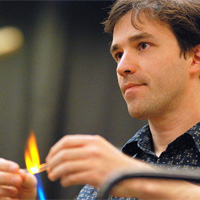 Dr. Keeling, who obtained his PhD in biochemistry at 色妹妹直播, working with Dal researcher and recent Herzberg Medal winner Ford Doolittle, is currently a faculty member at UBC. Last month, he visited campus as part of the Governor General Lecture Series hosted by the Royal Society of Canada, the country鈥檚 national academy of distinguished scholars in the arts, humanities and sciences.
Dr. Keeling鈥檚 lecture was titled 鈥淗ere Be Dragons,鈥� due to the unknown and mysterious nature of the microbial world. He talked about plasmodium malariae, a parasitic single-cell protozoan that is responsible for infecting humans with malaria disease.
An evolutionary mystery
鈥淧lasmodium is particularly special, because it gets inside our cells,鈥� he explained. 鈥淭his organism lives in the darkness of our bodies, so it was a surprise to find that it has a chloroplast. In plants and algae, photosynthesis takes place in the chloroplast. Why would an intracellular parasite, like malaria, contain the structure that plants use for photosynthesis? Where did the chloroplast come from?鈥�
Dr. Keeling explained that one of the reasons chloropasts are special is that they come from a process called endosymbiosis, where one cell eats another and retains it, the two fusing together and become one cell. This process is also responsible for the energy-producing mitochondria in our own cells.
In the case of the malaria-causing plasmodium, the answer to how the microbe obtained its chloroplast was found in an unlikely place. Researcher Bob Moore isolated a photosynthetic unicellular organism called Chromera at stony corals off the coast of Australia. By sequencing part of the genome of Chromera, Dr. Keeling and his team discovered that it was the most closely related relative to plasmodium. It was revealed that Chromera had secondary endosymbiosis with red algae, which finally answered how plasmodium got its chloroplast.
An emphasis on exploration
The fact that the evolutionary history of a major disease-causing organism could be revealed by a chance discovery among coral reefs serves as a case study for the importance of basic exploratory research, explained Dr. Keeling.
鈥淲e all sort of acknowledge that basic research is important, but there鈥檚 also a level of exploration that鈥檚 necessary to find the right questions. Sometimes we need to get in the boat and go look at things to see what we can find.鈥�