
 |
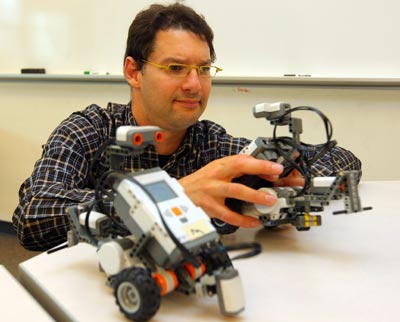
| Computer science professor Alex Brodsky teaches Animated Computing.聽(Nick Pearce Photo) |
With more than 3,700 classes on offer at 色妹妹直播, it's hard to keep track of changes in the course calendar. This week, we take a look at classes added recently to the undergraduate calendar.
Plenty of classes offer content beyond the basic lecture 鈥� lab work, tutorials, maybe a field trip. But only CSCI 1106 is hosting the Robot Olympics.
"It鈥檚 a hands-on class that gets kids more excited and involved in computer science," explains , computer science professor who will judge said sporting event.
First-year computer science courses usually focus on programming, sometimes a daunting introduction for freshmen with nothing but high school math under their belts. With聽Animated Computing聽(), Dr. Brodsky offers an alternative to programming.
"The majority of focus for this course is hands-on investigation, hands-on learning." Since this is his second-year teaching Animated Computing at 色妹妹直播, Dr. Brodsky has had time to troubleshoot. "We鈥檝e learned what works, and what doesn鈥檛 work, and actually spent the summer overhauling the course and making it better." (鈥榃e鈥�, in this case, refers to Profs Bonnie MacKay, Thomas Trappenberg, Patrick Connor, Connie Jess, and Dr. Brodsky himself.)
Robot module
Animated Computing is not about animation alone. The course is divided into three hands-on modules: robotics, web design and gaming. The robotics section of the course is Dr. Brodsky鈥檚 personal favourite: "I鈥檝e always been a big Lego fan."
Working in groups of three, students program "LEGO MINDSTORM" robots (the robots are roughly the size of a guinea pig and resemble WALL-E.) At the end of the "robotics" module, students compete in the Robot Olympics. Their Lego avatars navigate a maze, locate the ends on a piece of flat black tape, and wrestle each other, attempting to trigger an opponent鈥檚 touch sensor.
In the web design module, students use Dreamweaver to design their own websites. As they acquire new design skills, the emphasis remains upon ease of access for their audience. "It鈥檚 not 鈥榟ere鈥檚 what you can do with it,鈥� but 鈥榳hat is usable from the user鈥檚 perspective?鈥�" explains Dr. Brodsky, who draws inspiration from Nathaniel S. Borenstein鈥檚 Programming as if People Mattered. "When we do design websites, the important thing is that people are going to be using them. If nobody can figure out how to use it, it鈥檚 a useless website."
Students will first build a mock-up site for an animal shelter, then make their own site. The websites are evaluated from a user鈥檚 perspective 鈥� successful sites are easy to navigate, featuring high colour contrast and easily identifiable menus. Individual creativity is important too. Last year, one student made a "frosh manual" for 色妹妹直播 freshmen. Another made a "student plumbing manual."
In the last module, gaming, Dr. Brodsky鈥檚 students study the basic functions of simple games like Space Invaders. Then they extend that framework, designing their own Flash game. "What we鈥檙e really interested in is their reasoning process... we want the students to take what they have (learned) and extend it."
Students of last year鈥檚 gaming module designed ball-and-paddle "brlck" games, the kind that might come on a cell phone or Ipod. Some even improved on the original game. "One group made a two-player version," says Dr. Brodsky. "Whenever one person got rid of a brick, the brick went over to the other person鈥檚 side. They鈥檇 literally brick the person in."
Website design
Animated Computing satisfies the lab requirement for those undertaking a computer science degree, and undergraduate students pursuing degrees in other disciplines are also welcome. They may even be surprised by the ways in which they benefit from the class. You don鈥檛 have to be a computer whiz to find yourself suddenly required to design a website... and that鈥檚 just 2010.
"In the future, we鈥檙e going to be interacting with robots just the way we鈥檙e interacting with cars," Dr. Brodsky opines. Current English majors who design a robot鈥檚 English vocabulary 10 years from now may want insight into just how the thing鈥檚 mind works, anyway.
Conversely, computer science students will enjoy the opportunity to see their programming applied in the real world. "There鈥檚 a human aspect to computing... an oftentimes unspoken concept that the systems they create have to deal with the real world. The world is imperfect and it is uncertain." The crossover between the "ideal mind" of computers and the often messy "real world" fascinates Dr. Brodsky. "My research has been in both these camps... both in systems and theory." Animated computing is a class that deals in that middle ground, and promises students accessibility and applicability.
And robots.