
 |
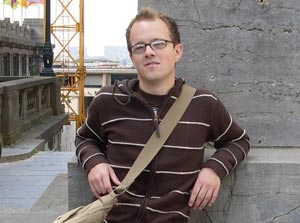
| Danny Jacobs is a poet and master's student in Library and Information Studies. (Photo supplied) |
"The easy answer is, that as writers, we all need jobs," says the poet Danny Jacobs. "I can鈥檛 make any money writing poems. So, you know, I want to be around things I love, which are books, and that鈥檚 the long and short of it."
That鈥檚 why he wants to be a librarian. Mr. Jacobs, and his colleague Nicole Dixon, come from a practical bread and roses school of thought where you seek a profession to support your vocation.
They are in the final year of their Masters of Library and Information Studies here at Dal and, while their future jobs may rest in libraries, their present vocations are literary. On Thursday, they鈥檒l read poems and stories in the Rare Books Room of the Killam Memorial Library.
|
Librarian-writers are not new. The profession has a long history of writers moonlighting as librarians: Jorge Luis Borges, Archibald MacLeish, Thomas Berger and Philip Larkin, to name a few.
"Oh yeah," Ms. Jacobs exclaims, "Larkin, the great librarian poet! He worked in libraries back in the days when libraries were still libraries. Now libraries are not libraries and that鈥檚 what鈥檚 such a huge thing for us to learn. We鈥檙e not librarians, we鈥檙e information managers. I don鈥檛 think someone like Philip Larkin could relate to what鈥檚 going on at all."
That鈥檚 not a yearning for the past as much as an awareness of how different the world is now. The students Jacobs seem to enjoy the idea of rummaging through their m茅tier to find its untapped poetry.
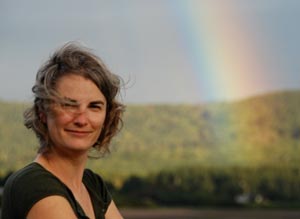 |
| Poet Nicole Dixon has a forthcoming collection called High-Water Mark. |
"There鈥檚 a lot of terminology that鈥檚 really fascinating," says Ms. Dixon. "It would be interesting to work with that terminology in poetry. Things like 鈥榗ontrolled vocabulary鈥� and 鈥榙atasets鈥� and all these kinds of crazy words we are constantly bombarded with."
"I don鈥檛 think there鈥檚 a lot of writing out there about technology in the world," she continues. "There is, but it tends to be science fiction. Why not? We are all so technological, and yet, it鈥檚 so often not in writing."
"There鈥檚 interesting poems buried somewhere that could be dug up," Mr. Jacobs agrees, while admitting to a love of scanning through scientific dictionaries looking for "poetic words."
If libraries have come a long way from the days of tweedy poet-librarians, they both see Canadian literature on track towards a new voice, too.
A lot of mainstream Canadian literature, Ms. Dixon feels "is pretty crappy. It鈥檚 really past-obsessed, it doesn鈥檛 connect with ordinary Canadians. It often takes place in rural communities, but those rural communities are not rendered correctly."
She spent eight years teaching elementary school in rural Nova Scotia. In her fiction, there is no nostalgia attached to rural life. When she reads her story "High-Water Mark" to classes at Dal she says, "I always have young women come up to me and say, "Thanks, You got it."
Likewise, Mr. Jacobs sees Canadian poetry energized by younger poets taking language in new directions. "It鈥檚 not just someone staring at a field. It鈥檚 really interesting language, it鈥檚 exploring how we can change our writing."
What鈥檚 great about a reading, Mr. Jacobs says, is the music. "People, when they read poetry, they are so obsessed with figuring out what it means that they sometimes lose the music. Which is the destruction of poetry to me if you don鈥檛 hear the music and sounds."
They will be reading Thursday, September 30, 7:30 p.m. in the Special Collections Reading Room on the 5th floor of the Killam Library. Call 494-3615 for more information.
SEE: