
 |
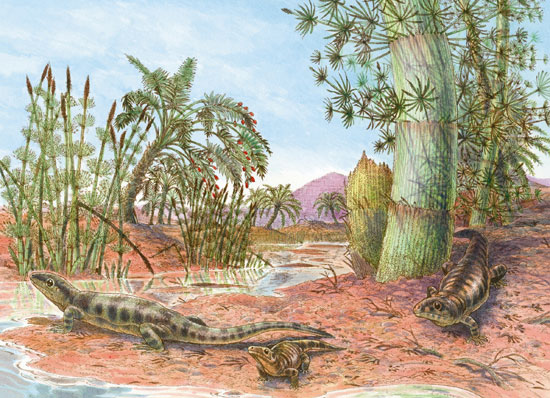
Ancient reptiles conquer continental interiors. (漏 James Robins Illustration) |
Some 315 million years ago, a reptile about the size of house cat took a walk along a dried up river bed, leaving its small, splayed footprints behind.
A few small steps for an ancient tetrapod,聽one huge step for science.聽Turns out that was some walk -- providing evidence that early reptiles were the first vertebrates able to live on dry river plains far from the sea. Meanwhile, their amphibian cousins were still hanging out 鈥減oolside,鈥� needing the wetter environment to breed, lay their eggs and reproduce.
| ||
| ||
|
鈥淭his is a major evolutionary development -- allowing our ancestors to live on land without having to beetle back to the water to reproduce,鈥� explains Martin Gibling, professor of Earth sciences and a co-author of a paper just published in journal Palaeogeography, Palaeoclimatology, Palaeoecology.
By 鈥渙ur ancestors鈥� Dr. Gibling clarifies: 鈥淢eaning vertebrates, from fish through amphibians to reptiles to birds, then through to us, mammals ... It鈥檚 a major step that allows larger animals to populate the land.鈥�
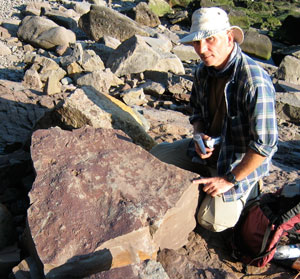
The聽reptile trackways preserved in rock were literally stumbled upon by the paper鈥檚 lead author, Howard Falcon-Lang of Royal Holloway, University of London, who grazed his knee as he scrambled over the fossilized slab. The rock -- 鈥渁bout the size of a filing cabinet,鈥� says Dr. Gibling -- had fallen out of a sea-cliff along the Bay of Fundy, near the town of St. Martins on New Brunswick鈥檚 southern coast.
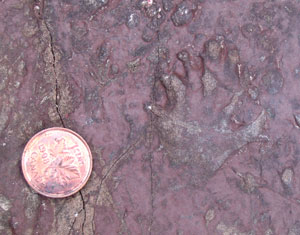
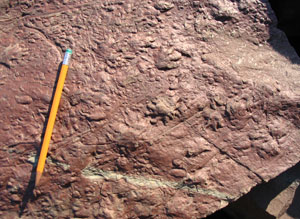
The tracks are abundant and indicate a few different kinds of reptiles were there, including one with slender digits and a narrow splay and another with a much stubbier foot. Also recorded in the rock are the mud cracks of a dry riverbed, the pitter-patter of raindrops and various plants.
It was Arden Bashforth鈥檚 job to examine that plant. He determined there were big, seed-bearing trees nearby that would have lived in a dry landscape.
The paper鈥檚 publication caps off his time at 色妹妹直播 nicely; he just defended his PhD thesis on paleoecology (the study of fossil organisms and their relationship to ancient environments) and is returning to Denmark where he just landed a job at a geological museum in Copenhagen.
READ: "Diverse tetrapod trackways in the Lower Pennsylvanian Tynemouth Creek Formation, southern New Brunswick, Canada" (PDF) by Howard J. Falcon-Lang, Martin R. Gibling, Michael J. Benton, Randall Miller and Arden R. Bashforth. Palaeogeography, Palaeoclimatology, Palaeoecology, 2010.