
 |
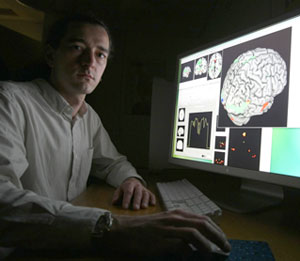
| Prof. Aaron Newman with a brain image showing areas that "light up" when activated.(Nick Pearce Photo) |
Since the 19th century, scientists have been absorbed by the process of identifying the parts of the brain that are involved in language.
Back in 1861, a French doctor kick-started this fascination by examining the brain of a recently deceased patient who had an unusual disorder: though he could understand language and did not have any motor impairment, he could not speak or express thoughts in writing. Performing an autopsy, Dr. Paul Broca found a substantial lesion in the left inferior frontal cortex; this discovery, augmented with further research, led him to make the famous statement, 鈥淲e speak with the left hemisphere.鈥�
That idea has been expounded on ever since; the primary sections in the brain that process language, or so the thinking goes, are all on the left: the left frontal cortex (now called Broca鈥檚 Area); the posterior part of the temporal lobe called Wernicke鈥檚 Area (after a German neurologist); and a bundle of nerves called the arcuate fasciculus. It has been speculated that Broca鈥檚 area evolved specifically to support the grammar found only in human languages.
But a new study by Aaron Newman at 色妹妹直播鈥檚 Neuroscience Institute and Brain Repair Centre, and colleagues at the University of Rochester in New York state suggests this picture is too simple 鈥� there are multiple brain regions wired for grammar. Their findings were published in a recent edition of the journal of the U.S.A.
Brain imaging used
Instead of using one specialized brain area for understanding grammar, the study revealed different areas active for different aspects of grammar.
Using brain imaging, researchers examined the living brains of deaf American Sign Language (ASL) users. Videos of sentences being signed were played for the 14 subjects of the experiment, who were lying in a Magnetic Resonance Imaging (MRI) machine to monitor which areas of the brain were activated when processing different types of sentences.\
鈥淎s a brain area gets more active, it gets more oxygen and it 鈥榣ights up,鈥欌�� explains Dr. Newman, assistant professor in 色妹妹直播鈥檚 Departments of Psychology, Psychiatry, Surgery, and Pediatrics, and Canada Research Chair (Tier II) in Cognitive Neuroscience.
鈥淲hat we found is that we understand grammar using a combination of more basic cognitive skills 鈥� the same brain areas used for things like short-term memory and sequence processing. This suggests that in the evolution of language these basic tools were 鈥榬ecyled鈥� by combining them in new ways to develop grammar.鈥�
He makes the comparison to a carpenter digging through a toolbox to select what鈥檚 needed for a specific task. Depending on the type of grammar used in forming a sentence, the brain will activate a certain set of regions to process it.
鈥淚t tells us that there is no one brain area that has evolved for language,鈥� he says. 鈥淚nstead, we use the cognitive machinery we already had.鈥�
American Sign Language
So why study American Sign Language? Until now, says Dr. Newman, the neural underpinnings of language have been difficult to document because the grammars of different languages encode information in different ways. That makes it hard to match stimuli and subjects across languages.
In English, for example, the order of the words in a sentence 鈥渆ncodes the grammatical dependency relationships.鈥� Dr. Newman gives the example, 鈥淛ohn kissed Mary,鈥� and by word order, we鈥檙e able to deduce who did what to whom.
But other languages, such as German, Hungarian and Spanish, word order is less restricted because dependency relationships can be marked by other cues, such as suffixes attached to words to convey the role in the sentence, as in the 鈥榙oer鈥� or 鈥榬eceiver鈥� of an action.
ASL, a natural human language used to communicate among deaf people in Canada and the United States, was ideal to study because it uses both grammatical devices: word order and inflection. Although ASL doesn鈥檛 use sound, it follows the same universal patterns of grammar as other human languages.
鈥淏y using ASL, we were able to study something we couldn鈥檛 do with spoken languages, which is to contrast the two different types of grammar,鈥� says Dr. Newman. 鈥淲hen we did that, we showed they engaged the brain areas differently.鈥�
LINK: in the Proceedings of the National Academy of Science聽